Structured Finance & Capital

Beyond conventional business finance.

Structured Finance & Capital

My value in this area comes from the position I occupy, the direct access I have to relevant people, the key partners I work with and the judgement to open the right doors in the right order. I bring these together around the client’s starting position, the difficulties they face and what they want to achieve.

Structured finance and wholesale banking can be unfamiliar territory. Some people arrive having pursued substantial returns or funding opportunities, only to encounter repeated introductions, changing requirements and transactions that never materialise. Time, money and confidence have been spent with little to show for it.

Others encounter these possibilities for the first time and find them difficult to assess. Unfamiliar language and ambitious claims can make the whole area seem too good to be true. The practical question is which proposals can withstand scrutiny and offer a credible route towards the client’s objective.

Position, access and sequence matter.

My relationships include monetisers, lawyers, private banks, family and sovereign offices, trading desks, buyers and key partners across the wider finance and advisory landscape. My position gives me direct access to these people, and these services:

  • Various Trade programmes, 799/760 hold/block, Buy-Sell.
  • REPO-Sale & Buyback (Government Bonds/MTN/UST).
  • Crypto-based trades, USDT/USDC/ETH/BTC.
  • Instrument monetisation.
  • Offshore business and bank accounts.
  • Currency exchanges, Fiat>Crypto & Crypto>Fiat.
  • BTC buyers
  • Gold/bullion/doré buyers
  • Gold-based bank SKR, based trade opportunities.
  • Fixed Income
  • Tokenisation Services

Once the client’s objective and their requirements are understood, it is easy to establish whether there is a basis for moving forward.

Knowing whom to approach is part of that. Knowing when to approach them, what must already be in place and how their involvement connects with the next stage is equally significant. An introduction made before the proposition is ready can lead nowhere.

Making the pieces fit.

I think of this as a jigsaw. The client brings a particular combination of resources, assets, commitments, constraints and ambitions. My position gives me direct access to people and potential routes that can help complete the picture.

The work is in establishing which pieces belong together, what is missing and the order in which each part needs to be brought into place. That can mean preparing the commercial proposition, involving legal expertise, clarifying a counterparty’s requirements or reconsidering the proposed structure before taking it further.

The objective could be funding a project, releasing liquidity or making better use of an existing position. The route must make sense for that client, including the costs, risks, obligations and practical steps involved.

Bring the position you are in and the outcome you are seeking.

From there, I can assess where my direct access, relationships and key partners may help, which doors are relevant and what needs to happen before each one is opened.


AI, Software & Business Intelligence

Start with the business problem. Build the technology around it.

AI, Software & Business Intelligence

My value in this area comes from understanding how a business works, recognising where its parts fail to connect and designing a practical way forward. I bring commercial judgement, systems thinking and hands-on development together around what the business needs to achieve.

AI has become the current buzzword. Business owners face a stream of products, promises and people selling solutions. It can be difficult to judge what is useful, what duplicates something already in place and what would require substantial change to deliver any value.

The important questions are what the technology will do, how it will be applied and where it belongs within the business. It may work alongside existing people and systems, replace a particular task, connect fragmented information or open the door to something entirely new.

Understand the operation before choosing the solution.

A business may already hold the information it needs, scattered across spreadsheets, emails, software and people’s heads. Staff repeat work, follow-ups get missed and the owner becomes the person through whom everything must pass.

Buying another application can add another layer to that complexity.

I start by examining how work moves through the business: where information enters, who needs it, what decisions follow and where responsibility sits. That helps establish what should be retained, improved, connected or replaced.

The answer may involve making better use of existing software, simplifying a process, connecting systems or building a tailored application. AI should have a defined role within that design, with a clear reason for its inclusion.

Apply intelligence where it makes a difference.

There may be value in using AI to organise incoming information, assist research, identify patterns, prepare material or support decisions. Other tasks may be handled more effectively through straightforward software and automation.

The design needs to establish what can happen automatically, what requires review and who remains responsible. Data quality, confidentiality, reliability and the consequences of an incorrect output all influence how a system should operate.

My role is to assess these choices in their commercial context and help turn the useful ones into something workable. The effort and cost of implementation, ongoing maintenance and the people using the system are part of that assessment.

Turn information into useful action.

Business intelligence should help answer the questions that matter: What needs attention? Where are opportunities being missed? Which relationships could be relevant? What is changing, and what should happen next?

That could mean giving a leadership team a clearer view of performance, connecting client information with follow-up activity or making knowledge available to the people who need it.

The value comes through clearer decisions, timely action and stronger control over the business.

Create new possibilities.

This work can also begin with an opportunity: an underserved market, a missing service or a better way to connect people, information and transactions.

I help shape how that opportunity could operate as a business. That includes the service itself, the customer experience, the revenue model and the processes and systems needed to deliver it. Software and AI can form part of the infrastructure that makes the proposition possible.

From there, the work moves into building, testing and refining, bringing in specialist capability where required and learning from actual use.

What should your business be able to do that it cannot do effectively today?

That is a useful starting point. We can then establish what needs to change, where technology can add value and how to bring the solution into everyday operation.

AI Is Everywhere. Where Does It Actually Add Value to Your Business?

The opportunity begins with understanding what your business should be able to do better.

A business owner surrounded by competing streams of cyan and gold light, with one clear gold path emerging.

Business owners are being sold AI from every direction.

New platforms. Automated assistants. Content generators. Systems promising to transform sales, cut costs or run entire departments.

Some will prove useful. Others will add another subscription, another disconnected process and another demand on your team.

For an owner already managing customers, staff, cash flow and delivery, the difficulty is knowing where to begin.

What can AI actually do for this business? Which claims deserve attention? What should you invest in, and how do you make it work across the business?

These are commercial questions before they become technology decisions.

Start with the work

Before choosing a tool, look at how the business operates.

Where do people repeatedly search for information? Which tasks involve copying, checking, summarising or preparing the same material? Where do enquiries wait, handovers fail or decisions depend on one person’s knowledge?

These are useful starting points because the problem already exists and the value of improving it can be assessed.

AI might help prepare a first response to an enquiry, extract information from documents, make internal knowledge easier to find or assist a team in reviewing complex material.

Some problems will be better solved through straightforward automation, better software or a clearer process.

The skill is in understanding the difference and choosing accordingly.

A useful tool must fit the business

A demonstration can look impressive while telling you very little about everyday usefulness.

Can the system work with your information? Does it connect with the software your team already uses? Who checks its output? What happens when it gets something wrong?

If someone must repeatedly move information between systems, repair the output and maintain a separate spreadsheet to keep track, the apparent saving may disappear.

Successful implementation means following the work from beginning to end: what comes in, what should happen, who remains responsible and how the result reaches the person who needs it.

That may involve configuring an existing product, connecting several systems or developing something around a particular requirement.

The objective is a working improvement that people can use consistently.

Give your team more capability

There are real opportunities to reduce repetitive work and overheads. Some tasks will disappear, some roles will change and some staffing requirements may reduce.

But there is also a substantial opportunity to make the team you already have more capable.

People can spend less time finding and assembling information and more time applying their experience. They can prepare work faster, access knowledge beyond their immediate role and give customers more informed responses.

That requires training, clear expectations and an understanding of the limits. AI can produce convincing mistakes. Responsibility for decisions and commitments must remain clear.

Used well, it can extend your team’s reach while preserving the judgement that makes their work valuable.

Prove the value before expanding

You do not need to redesign the whole business at once.

Choose a worthwhile problem. Establish how it is handled today, introduce a controlled improvement and assess what changes.

Does it save time after checking and corrections? Does it improve quality or response speed? Does the team use it? Are the costs and ongoing effort justified?

Then refine it and decide where to go next.

The market will keep developing. Your choices should leave room to adapt, with attention to access, confidentiality, maintenance and dependence on individual suppliers.

Understand the whole commercial position

Unravelling this market and translating it into practical business use has become a key part of my work.

I bring the commercial view together with systems thinking and hands-on development: understanding the requirement, evaluating the options and connecting the right elements through to deployment.

Building WolfIntel around my own work has reinforced how much the value depends on the structure around the technology—how information connects, how people use it and what it enables them to do next.

You do not need to become an AI expert before making progress.

You need a clear understanding of your business, the outcomes worth pursuing and a practical way to establish what works.

What should your business be able to do better, faster or at lower cost than it does today?

Bring that question. We can work through where AI may help, what needs to change around it and how to turn the opportunity into something useful.

Building WolfIntel: From Information to Action

Why I built one working environment around the way I think and operate.

Interwoven gold and teal connections forming a unified structure against navy.

Knowing the right people and holding the right information is only useful if I can bring it together when it matters. A conversation may point to a need. Another contact may offer a possible route. The evidence and previous work may be somewhere else entirely. If I have to reconstruct that picture each time, valuable time goes into finding information instead of using it.

My work involves a constant flow of people, organisations, propositions, documents and follow-ups. I needed more than a place to file them. I needed to see how they connected, understand the position at any level of detail and know what required my attention next.

That is why I built WolfIntel.

Give information a place where it can be used

A contact list, a spreadsheet and a document store each serve a purpose. But separate tools leave much of the work of connecting them to the person using them.

In WolfIntel, the information I need to retain has a place within one working environment. People and organisations can be connected to their relationships, capabilities, needs and offers. Jobs have an owner, a current position, a next action and a history. Documents and notes can sit alongside the work they concern.

This gives me both a broad view of everything in motion and the ability to examine one person, opportunity or decision in detail. Information is no longer useful only if I happen to remember where I put it.

Work without constantly changing environments

I have also brought the functions of three other websites I used into the same environment. I can move between the work, the people involved, my calendar, documents and the wider network without repeatedly leaving one system to find something in another.

That has made me considerably more efficient and saved me time each week. The value is not just fewer clicks. I can follow a line of thought while the context is in front of me: find the person, examine what is known, check the related work and decide what should happen next.

The Action Desk and morning view help me manage immediate demands. The Directory and Network let me explore relationships and possible routes. Together, they make it easier to move between the global picture and the detail behind it.

Ask better questions of what I already know

Oracle adds another dimension. I can ask questions across the information I am permitted to see and bring relevant records, documents and history into view. It gives me context and points back to the underlying material, so I can examine the basis for what I find.

That can reveal an earlier conversation, a related need or a piece of evidence I might not otherwise have brought to mind. It helps me develop insight and make better-informed decisions later. It does not decide whether a reported claim is true or whether two parties should do business; that judgement still requires scrutiny.

The same principle applies when WolfIntel shows possible matches between needs and offers. They are leads to investigate, not conclusions presented as fact.

A system that can change with the work

WolfIntel is not a fixed set of screens built around one moment in time. My demands and workflows change. I can develop the system with them—refining how information is captured, how work is presented and which connections are useful. It has been built to be practical to deploy, manage and update rather than becoming another piece of software that dictates how I must work.

Building it has also shown me a wider possibility. Another person or organisation may recognise the same difficulty: plenty of knowledge and activity, but no clear way to connect it and act on it. I would not assume their work is identical to mine. I would first understand how it operates and what is getting in the way. Where a connected system would help, WolfIntel could provide a foundation tailored to their needs.

I began with a problem in handling my own work, designed the structure around it and took it through to a working system. If you face a similar gap between what you know and what you can readily use, that is a conversation worth having.

WolfIntel, your business, working as one. Get the full rundown, click here!

My business is growing but becoming harder to control. Why?

Growth is not always evidence that a business is becoming stronger.

My business is growing but becoming harder to control. Why?

More orders, more staff and higher turnover can look like success while the business becomes increasingly difficult to run. Decisions queue at the owner’s door. Customers chase updates. People work harder, yet deadlines slip and cash feels tighter.

One possibility is that the business has outgrown the way it operates. The informal arrangements that worked with a small team may no longer give people the information, authority or support they need.

Find where control is being lost.

I start by looking at the journey from enquiry to delivery and payment. Where does work wait? Where is information entered twice? Who can approve a decision? Which problems repeatedly come back to the owner?

Those questions help distinguish a capacity problem from a structural one. Another employee may help an overloaded team, but an unclear handover or conflicting priorities will still need resolving.

It is also important to look beneath turnover. Which customers and activities contribute worthwhile margin after the cost of delivery, rework and support? How long does it take for completed work to become cash? Growth needs to be understood through those details.

Give people the authority to deliver.

Delegation works when the outcome, responsibility and limits of authority are clear. Someone needs to own each important stage, know what a good result looks like and understand when an issue should be escalated.

A short, consistent review of workload, delivery, cash and exceptions can make problems visible while there is still time to act. The information should lead to decisions and named actions, rather than another report that nobody uses.

For example, repeated late deliveries may begin with promises made during the sales process. Reviewing scheduling alone would miss the point. Sales, operations and finance need a shared view of what can be delivered, at what cost and on which terms.

Build the structure for the next stage.

My experience of rapid growth and contraction shapes how I approach these situations. I look at the commercial model, the people, the information and the execution together, then identify the changes with the greatest practical effect.

That may involve clarifying responsibilities, changing pricing, tightening the acceptance of new work, improving systems or bringing in management capability. The sequence matters: resolve the immediate pressure while building a way of operating that can support further growth.

Where does the business still depend on you personally?

That is often a useful place to begin. Understanding those dependencies can reveal what needs to change so that growth becomes more manageable, profitable and sustainable.

What options exist beyond conventional business finance?

The funding route should fit the commercial purpose.

What options exist beyond conventional business finance?

A business may have a credible opportunity and still struggle to fit the requirements of its usual bank. That raises a useful question: is the obstacle the funding source, the proposed structure or the readiness of the business itself?

Before looking further afield, I want to understand what the capital must achieve, how much is needed, when it is needed and what will support repayment or an investor’s return. The answer shapes which conversations are worth having.

Start with the requirement.

Funding equipment, bridging a payment gap and developing a new venture are different requirements. Treating them as one general request for money can obscure the strongest part of the proposition.

There may also be scope to reduce the requirement through staged delivery, better payment terms or a different commercial arrangement. Those possibilities deserve attention alongside external funding.

Consider the available routes.

Depending on the circumstances, the discussion may include specialist lending, finance linked to assets or receivables, equity investment or a commercial joint venture. Each brings different expectations around cost, security, ownership, control and timing.

For a business waiting to be paid by business customers, invoice finance can provide access to part of the value of eligible unpaid invoices. Availability depends on the provider’s assessment and the quality of the receivables. Fees, customer arrangements and obligations if an invoice is unpaid need to be understood. British Business Bank: invoice finance explained.

Equity introduces an ownership relationship, so the choice of investor and the agreed rights matter as well as the amount raised. A commercial partner may bring capability, customers or infrastructure alongside capital. The fit between the parties becomes part of the proposition.

For more complex circumstances, structured finance and wholesale banking relationships may warrant exploration. The underlying assets, transaction terms, counterparties and documentation determine whether a proposed route is workable. The existence of an instrument or an introduction does not establish that funding will follow.

Prepare before opening doors.

My role is to bring the commercial position into focus and assess where my direct access, relationships and key partners may help. That includes identifying what needs to be clarified before an approach and involving the relevant expertise in the right order.

A useful funding proposition explains the use of funds, the assumptions behind the numbers, the risks and the evidence supporting the plan. It should also show what happens if trading is slower, costs rise or delivery takes longer than expected.

The terms need to work beyond the day the money arrives. Repayment commitments, guarantees, security, ownership rights and exit arrangements can materially affect the business later.

What must the funding enable?

Bring the objective and the current position. From there, we can assess the preparation required and which routes merit a serious conversation. The aim is a structure the business can use productively and live with over time.

Should we buy software, automate the process or build our own?

Choose around the work the business needs to perform.

Should we buy software, automate the process or build our own?

A business needs a better way to manage enquiries, coordinate delivery or make information available. The next conversation quickly becomes about software: buy a package, automate the existing process or commission a new system?

I begin by defining the work. What should happen, who needs to do it, what information is required and how will we know the result is better? Those answers provide a basis for assessing the options.

Understand the process first.

Take an enquiry that arrives by email, is copied into a spreadsheet and is then passed between several people. The problem may include missing information, unclear ownership and no agreed follow-up.

Automating the copying could save time, but responsibility and the next action still need to be designed. Once the process is clear, it becomes easier to see what technology should support.

Buy where the fit is strong.

An existing product is worth considering where it handles the essential requirements well and the business can work sensibly within its structure. I would assess it using real tasks and representative data, including the awkward cases that a demonstration may leave out.

The assessment should cover implementation, training, integration, ongoing charges and the ability to retrieve your information if you later move. A low starting price is only one part of the decision.

Automate work that is understood.

Automation is a candidate where a task repeats and its rules can be described clearly. The design should include exceptions: incomplete information, duplicate records, failed transfers and situations requiring a person’s decision.

AI may support tasks involving less structured material, such as helping organise incoming documents or preparing a draft for review. Its role needs clear boundaries, suitable data access and a way to check the result. Some tasks are better served by simple, predictable rules.

Build where the difference matters.

A tailored system may deserve consideration where the workflow is distinctive, existing products leave a substantial gap or the system itself supports a new service or commercial advantage.

The commitment includes maintaining it, protecting the data, documenting how it works and ensuring someone can support it. I favour beginning with a useful, bounded part of the operation, testing it with the people who will use it and extending it on the strength of that experience.

Buying, automation and custom development can also work together. A standard system may remain at the core, with targeted connections or a tailored interface addressing a specific gap.

Make the decision commercially.

My role is to connect the operational requirement with the design and delivery of a workable solution. The test is whether it improves the business sufficiently to justify the cost, disruption and ongoing responsibility.

Start with one important task that currently creates friction. Map it, define the outcome and assess the options against that same requirement. That gives the technology decision a practical foundation.

A business becomes vulnerable when everything depends on the owner.

A business owner surrounded by specialist advisers, each focused on their own area.

Many owner-managed businesses appear successful from the outside.

  • Customers are being served.
  • Staff are being paid.
  • Revenue is coming in.
  • Problems are being dealt with.

But underneath that activity, the owner is carrying almost everything.

  • The important client relationships.
  • The commercial decisions.
  • The sales pipeline.
  • The difficult staff issues.
  • The funding conversations.
  • The supplier negotiations.
  • The problems nobody else can resolve.

That may work while the business is small.

It becomes a serious constraint when the business starts to grow.

Decisions slow down because everything needs approval.

Staff avoid responsibility because the owner will eventually take over.

Opportunities are missed because there is no capacity to assess or pursue them properly.

The owner becomes permanently busy but increasingly unable to focus on the decisions that matter most.

The answer is not simply to work harder.

It is to identify:

  • what only the owner should be doing;
  • what should be delegated;
  • where responsibility is unclear;
  • which decisions need better information;
  • and what commercial structure is missing.

A business should benefit from the owner’s capability.
It should not be entirely dependent upon it.

When the owner becomes the principal operational bottleneck, the business has reached the point where structure is no longer optional.

Does this sound like you?

DM me for a discreet one-on-one. A focused initial conversation is often enough to establish whether I can add value.

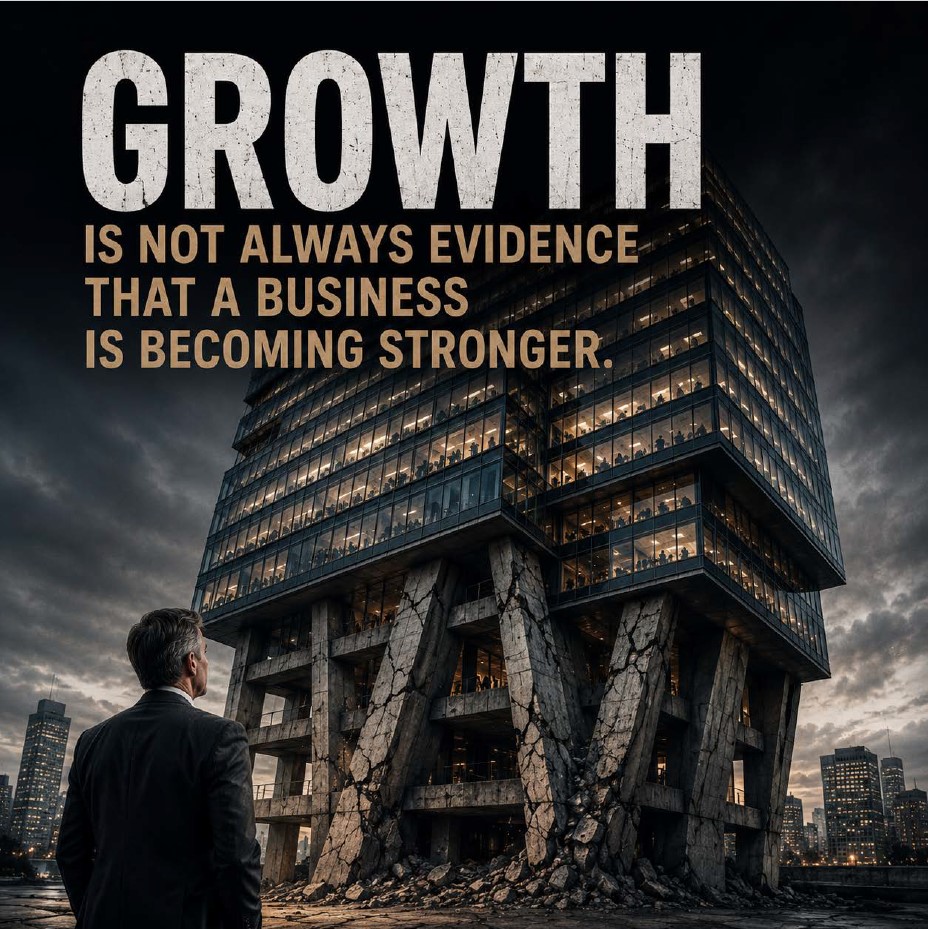
Growth is not always evidence that a business is becoming stronger.

A growing office tower resting on cracked foundations.

Sometimes it is simply becoming larger.

  • More customers.
  • More staff.
  • More transactions.
  • More suppliers.
  • More problems.
  • Revenue may be increasing while margins are falling.
  • The sales team may be winning work that operations cannot deliver properly.
  • New employees may be joining without clear roles, accountability or management.
  • Customer information may be held across emails, spreadsheets, notebooks and individual heads.
  • Cash requirements rise before the financial impact of growth is properly understood.
  • From the outside, the business looks busy and successful.
  • Inside, the owner feels that control is slipping.

This is one of the most dangerous stages in the development of an owner-managed business.

The opportunity may be genuine, but the operating structure has not kept pace.

Sustainable growth requires more than demand.
It requires:

  • commercial visibility;
  • defined responsibilities;
  • margin control;
  • disciplined sales processes;
  • operational capacity;
  • reliable management information;
  • and clear decision-making.

Growth should create value.

It should not create a larger, more complicated and more expensive problem.
When growth begins to reduce control, the priority is not always to sell more.

The priority is to stabilise, structure and regain visibility before pushing forward again.

Does this sound like you?
DM me for a discreet one-on-one. A focused initial conversation is often enough to establish whether I can add value.

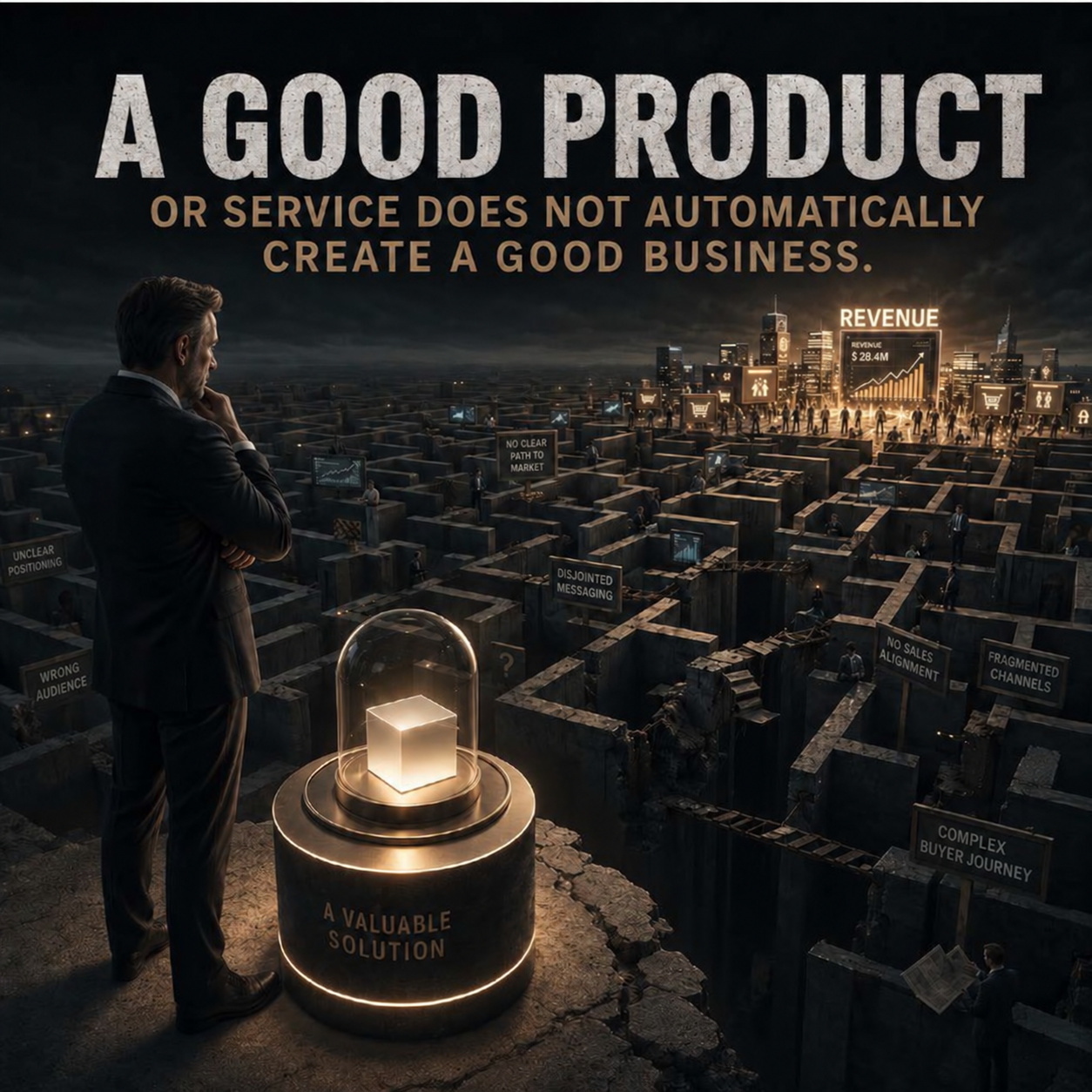
A good product or service does not automatically create a good business.

A business owner looking across a commercial maze towards revenue.

I regularly see businesses with genuine capability, credible experience and something useful to offer.

But the commercial pathway is unclear.

They cannot answer, with enough precision:

  • Who is the real customer?
  • What urgent problem are we solving?
  • Why should they buy from us rather than somebody else?
  • How do we reach them?
  • What is the sales process?
  • Who owns each stage?
  • How does interest become revenue?

The business may be active, but activity is not the same as commercial progress.

  • Marketing produces conversations.
  • Networking produces contacts.
  • Proposals are sent.
  • Meetings take place.

But conversion remains inconsistent because the route to market has not been properly designed. The answer is rarely “more marketing.”

The business first needs clarity around:

  • the target customer;
  • the commercial problem;
  • the proposition;
  • pricing;
  • market positioning;
  • sales channels;
  • conversion process;
  • and follow-up discipline.

A route to market is not a list of promotional activities.
It is a controlled process that takes a defined customer from initial awareness to a commercial decision.

Until that process is clear, revenue will remain unpredictable and too dependent upon luck, personal relationships or occasional opportunities.

Does this sound familiar?
DM me for a discreet one-on-one. A focused initial conversation is often enough to establish whether I can add value.

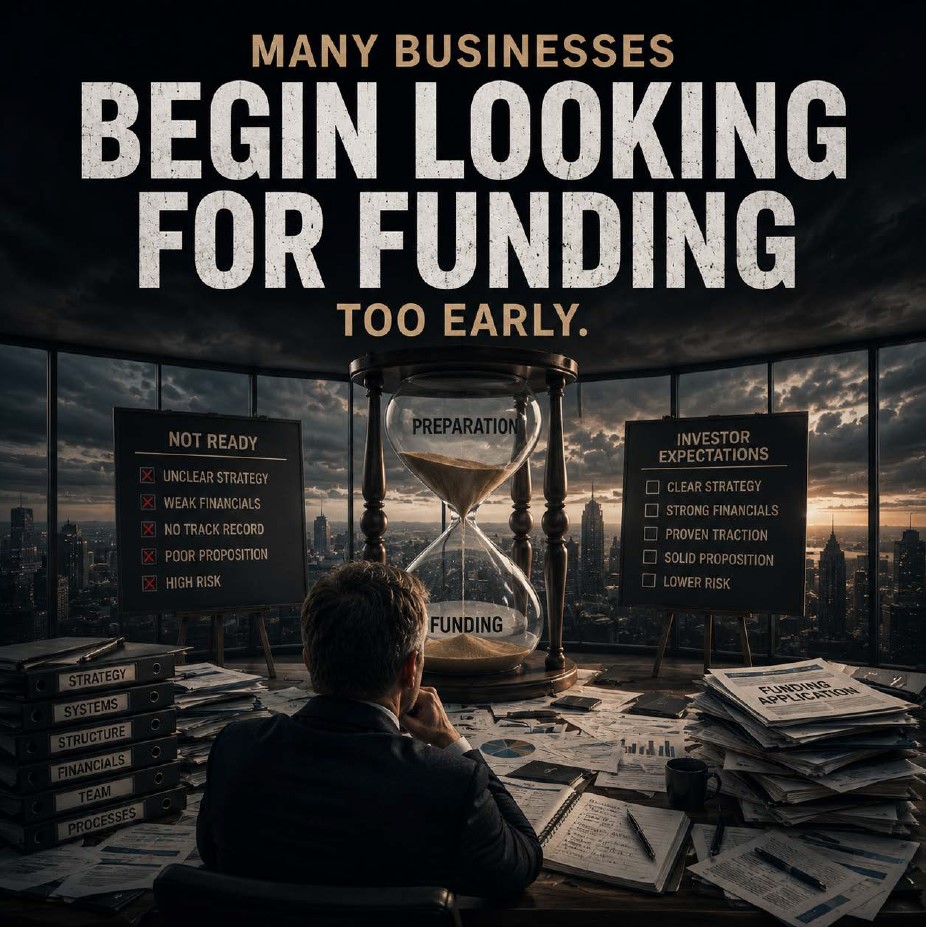
Many businesses begin looking for funding too early.

A business owner preparing a funding case beside an hourglass and investor expectations.

Not because the opportunity is too early.
Because the commercial case is not ready.

The owner understands the business because they live with it every day.
The investor or lender does not.

They see:

  • An unclear funding requirement.
  • A weak explanation of how the money will be used.
  • Financial assumptions that are not connected to an executable plan.
  • A valuation without sufficient rationale.
  • Risks that have not been addressed.
  • Documents that describe the opportunity but do not build confidence in it.
  • The result is often rejection, delay or a conversation that goes nowhere.
  • The owner may conclude that the investor “did not understand the business.”

Sometimes that is true.

More often, the opportunity was not presented in a way that allowed the investor or lender to understand it quickly and assess it properly.

Before approaching funding sources, the business should be able to explain:

  • what it does;
  • why the opportunity exists;
  • how it makes money;
  • how much funding is required;
  • exactly how the funds will be used;
  • what the key risks are;
  • how those risks will be managed;
  • and what the funder receives in return.

Funding readiness is not simply producing a polished presentation.

It is making the commercial proposition coherent, credible and capable of surviving scrutiny and standing out from the rest of the opportunities on their desk!

Good businesses can fail to secure funding because they are poorly prepared.
That is avoidable.

Does this sound like you?
DM me for a discreet one-on-one. A focused initial conversation is often enough to establish whether I can add value.

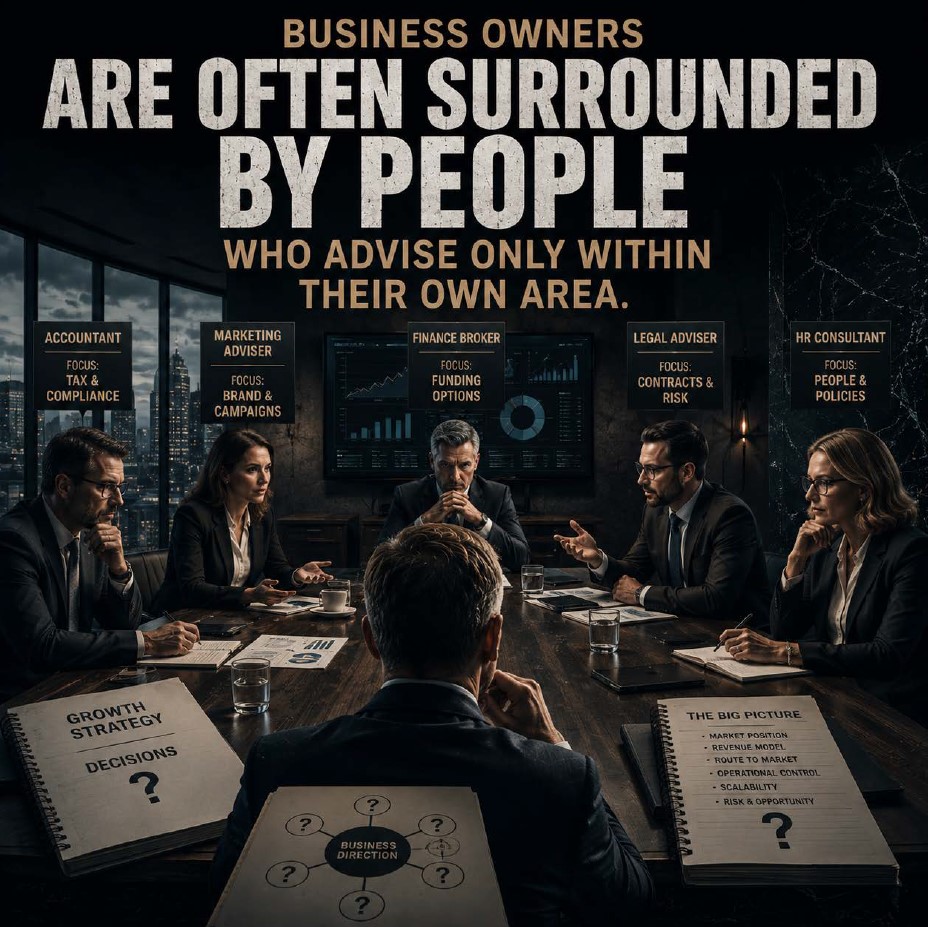
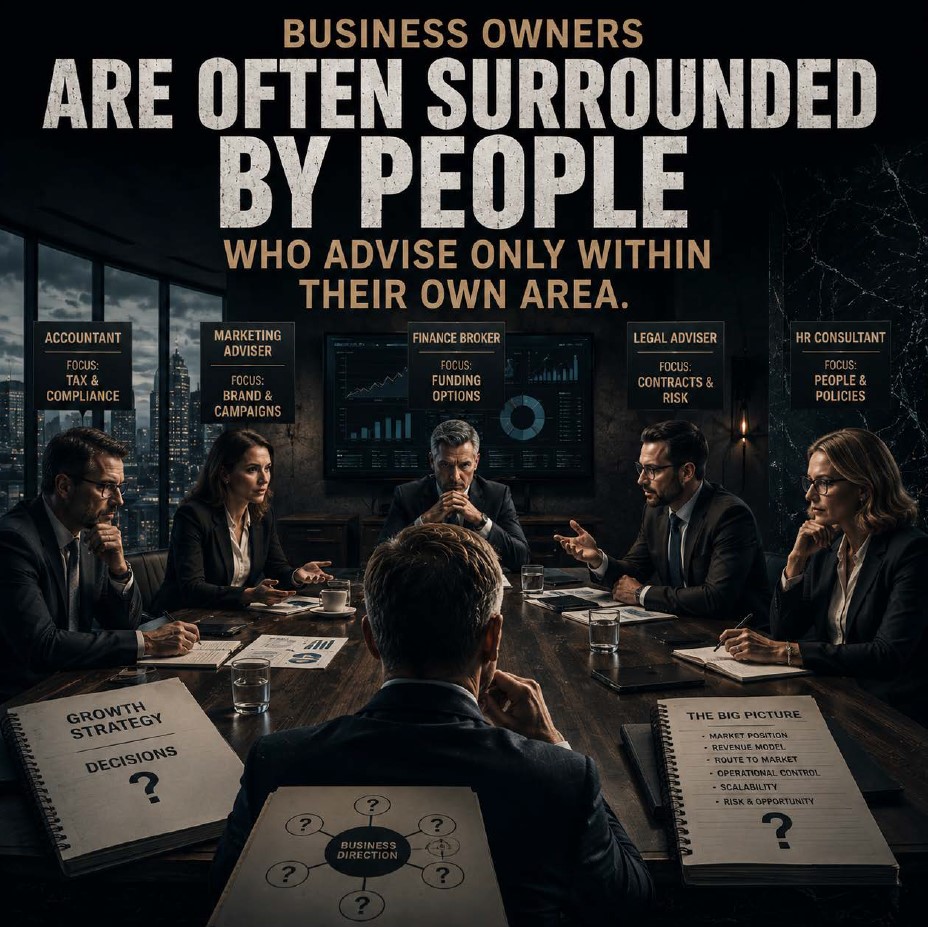
Business owners are often surrounded by people who advise only within their own area.

A business owner surrounded by advisers with separate specialist perspectives.
  • The accountant considers the numbers.
  • The solicitor considers the legal position.
  • The finance broker considers whether funding may be available.
  • The sales team considers revenue.
  • The operational team considers delivery.

Each view may be valuable.

But who is assessing the whole commercial position?

A major decision rarely sits neatly within one discipline.

  • An acquisition may be legally achievable but commercially weak.
  • A funding offer may provide capital but create unacceptable obligations.
  • A new market may appear attractive but require infrastructure the business does not possess.
  • A partnership may bring opportunity but weaken control.
  • A growth plan may increase turnover while damaging margin and cash flow.

Owner-managers are also often too close to the situation.

They have invested time, money, emotion and reputation.

That makes independent commercial challenge particularly important.

Before making a significant decision, the questions should include:

  • What is the real commercial objective?
  • Where is the value being created?
  • Who carries the risk?
  • What assumptions have not been tested?
  • What happens if the plan underperforms?
  • What control is being surrendered?
  • Is there a better structure?
  • Should the business proceed at all?

The purpose of independent advice is not to slow down a good decision.
It is to prevent enthusiasm, pressure or incomplete information from creating a bad one.

Sometimes the most valuable commercial contribution is not producing another idea.

It is identifying the weakness in the current one before the business commits.

I work with founders and owner-managed businesses that need an experienced, independent commercial view before making an important decision, change, or commitment. A focused initial conversation is often enough to establish whether I can add value.

Founders need structure before momentum is wasted.

A commercial adviser reviewing plans and documents spread across a boardroom table.

Established businesses need control before growth becomes risk.
Businesses under pressure need clarity before problems become terminal.

I work where commercial issues are complex, urgent and need intervention, supporting founders, owners, investors and project-led businesses that need commercial capability quickly.

Most businesses do not fail because the opportunity is poor. They fail because commercial structure is weak.

Routes to market are unclear.
Funding strategies are underdeveloped.
Growth plans are not practical.
Investor or lender stories do not land.
Owners are carrying too much alone.
Execution is fragmented.

That is where I add value.

Over the last 30 years, I have built, scaled, restructured and operated businesses across finance, training, IT, renewable energy, credit brokerage, structured finance and project funding.

I have built businesses from the ground up, created commercial models, recruited teams, developed routes to market, built lender, partner and sales networks, structured funding propositions and negotiated at board level.

My work is focused on three areas:

Interim Commercial Director / Growth Director

I support businesses that need senior commercial direction without a permanent board appointment. I assess the current position, identify what is blocking growth, impose structure, sharpen the revenue model and move the business from discussion into execution.

Funding Readiness & Investor/Lender Documentation

Many businesses seeking funding are not properly prepared. The commercial case is unclear, documents are weak, use of funds is not disciplined, and the investor or lender story lacks confidence. I structure the proposition so the business can present itself clearly and credibly.

Practical Growth Strategy

Growth is not just about selling more. It requires clear market position, defined customer, credible offer, controlled operating model, financial discipline, the right people and an executable route to market.

My background includes scaling a Green Deal / ECO group from £4,000 to £24m turnover in 15 months, with 137 staff and 40+ contractors. I built a Solar PV business from scratch to £5m turnover in under a year. I created an FCA-regulated credit brokerage, onboarding 50+ lenders.

More recently, I have worked across project funding, wholesale structured finance, investor documentation, M&A, commercial deals and global trade.

I am not selling theory.

I help business owners see clearly, unravel complex issues, build commercial structure and move quickly from problem to execution.

If you are a founder, owner, investor or adviser dealing with a business to launch, growing too quickly, losing control or facing commercial pressure, I can help.

I step in quickly, identify the real issues, bring structure to the situation and help move the business from pressure to a workable plan.